Mexican - Menu: A Strategic Template for Streamlined Restaurant Branding
In the competitive landscape of the food and beverage industry, the physical or digital menu is often the most critical touchpoint between a business and its customer. It is not merely a list of prices and dishes; it is a primary sales tool, a brand ambassador, and a guide for the dining experience. For entrepreneurs, restaurant owners, and graphic designers, creating a menu that balances aesthetic appeal with functional clarity is a complex challenge. This is where the Mexican - Menu template serves as a vital resource. Designed specifically for those who sell, manage, or operate food-related businesses, this template offers a structured foundation that simplifies the design process while enhancing customer decision-making.
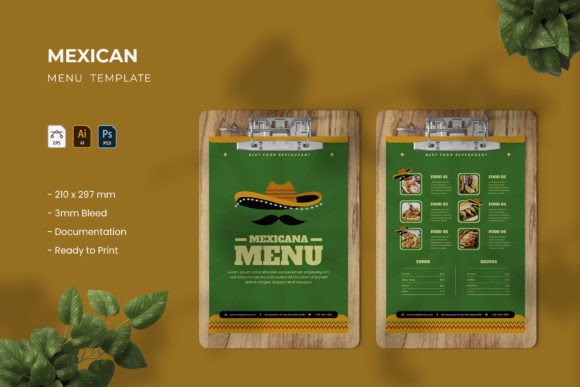
The core philosophy behind effective menu design is rooted in cognitive psychology. When customers are presented with too many choices, excessive colors, or cluttered layouts, they often experience decision paralysis. This phenomenon can lead to longer ordering times, customer frustration, and ultimately, lower satisfaction. The Mexican - Menu addresses this by providing a clean, modern layout that limits visual noise. By organizing content into easily scannable sections, the template helps customers find what they want quickly, facilitating a smoother transaction process. For business owners, this efficiency translates directly into improved table turnover rates and a more positive overall guest experience.
Integrating the Template into Your Design Workflow
Adopting a pre-designed template like Mexican - Menu does not mean sacrificing uniqueness. Instead, it allows creators to focus on customization and brand alignment rather than starting from a blank canvas. The template is fully editable and comes in professional file formats, including AI, EPS, and PSD. This compatibility ensures that whether you are using Adobe Illustrator for vector-based precision or Photoshop for raster-based adjustments, the workflow remains seamless. For freelancers and agencies managing multiple clients, this flexibility is crucial. It allows for rapid iteration and adaptation to different brand identities without compromising on structural integrity.
The technical specifications of the template are designed for high-quality output. With dimensions of 21w × 29h cm (8.2 x 11.7 inches), it adheres to standard international paper sizes, making it ideal for both handheld menus and table tents. The files are set to CMYK color mode at 300 DPI, which is the industry standard for professional printing. This ensures that colors appear vibrant and accurate when printed, avoiding the dullness or pixelation that can occur with lower-resolution or RGB-only files. For small business owners who may not have extensive design knowledge, knowing that the file is "print-ready" provides significant peace of mind. It reduces the risk of costly printing errors and reprints, allowing resources to be allocated to other areas of the business.
Optimizing Layout for Customer Psychology
One of the standout features of the Mexican - Menu is its emphasis on organization. The layout is engineered to guide the eye naturally through the offerings. In a practical workflow, this means that high-margin items or signature dishes can be strategically placed in prime real estate areas of the page. The clean and modern aesthetic ensures that these items stand out without relying on aggressive or tacky design elements. By limiting the number of colors and design distractions, the template encourages customers to focus on the food descriptions and images, which are the primary drivers of appetite and purchase intent.
Furthermore, the template includes well-organized layers. For designers, this is a time-saving feature that cannot be overstated. Instead of sifting through a chaotic mix of unlocked and hidden elements, users can easily isolate text boxes, image placeholders, and background graphics. This organization facilitates efficient updates. In the restaurant industry, menus change frequently due to seasonal ingredients, price fluctuations, or supply chain issues. A well-structured template allows for quick edits, ensuring that the printed menu always reflects the current offerings. This agility is essential for maintaining operational consistency and avoiding the embarrassment of serving items that are no longer available.
Practical Implementation and Customization Tips
To get the most out of the Mexican - Menu template, it is important to approach customization with a strategic mindset. Begin by auditing your current menu items. Identify which dishes are your best sellers and which ones have the highest profit margins. These should be given prominence in the layout. Use the template’s stylish layout options to create visual hierarchy. For instance, you might use bold typography for section headers and a lighter weight for descriptions. The template supports the use of free fonts, which means you can maintain a professional look without incurring additional licensing costs. However, ensure that the fonts you choose align with your brand’s personality. A modern, minimalist font might suit a contemporary fusion restaurant, while a more traditional serif could work better for a classic cantina.
Color usage is another critical factor. While the template provides a clean base, you should incorporate your brand’s primary colors sparingly. Use color to highlight special items or denote dietary information, such as vegetarian or spicy options. Avoid using too many contrasting colors, as this can revert the design to the cluttered state the template aims to avoid. The goal is to create a harmonious visual experience that complements the food rather than competing with it. Remember, the menu is part of the overall ambiance of the restaurant. It should feel like a natural extension of the interior design, service style, and culinary concept.
Additionally, consider the physical context in which the menu will be used. Will it be handed to customers at the door, placed on tables, or displayed at a counter? The 8.2 x 11.7 inch size is versatile, but you may need to adjust the font size based on lighting conditions. Dimly lit restaurants require larger, high-contrast text to ensure readability. The high-resolution 300 DPI specification of the Mexican - Menu ensures that even if you scale certain elements, the quality remains sharp. Always print a proof copy before committing to a large run. Check for alignment issues, color accuracy, and readability under actual dining conditions. This quality control step is essential for maintaining professional standards.
Long-Term Value and Business Efficiency
Beyond the immediate design benefits, using a standardized template like Mexican - Menu contributes to long-term business efficiency. For multi-location businesses or franchises, consistency is key. A uniform menu design across all locations reinforces brand recognition and ensures that customers receive a consistent experience regardless of which branch they visit. The editable nature of the AI, EPS, and PSD files allows central marketing teams to update master templates and distribute them to local managers, who can then make minor localized adjustments if necessary. This centralized control reduces the risk of brand dilution and ensures that all promotional materials meet corporate standards.
For independent restaurateurs and freelancers, the template serves as a reliable asset in their toolkit. It reduces the time spent on initial design concepts, allowing more time to be devoted to client consultation, photography, and copywriting. The inclusion of documentation and a readme file further supports this efficiency by providing clear instructions on how to edit and export the files. This support is particularly valuable for users who may not be expert designers but need to produce professional-grade materials. By lowering the barrier to entry for high-quality design, the Mexican - Menu empowers small business owners to compete with larger establishments that have dedicated design departments.
In conclusion, the Mexican - Menu is more than just a graphical layout; it is a strategic tool for enhancing restaurant operations and customer satisfaction. By combining professional technical specifications with a user-friendly, psychologically informed design, it addresses the common pitfalls of menu creation. Whether you are launching a new eatery, refreshing an existing brand, or managing design assets for multiple clients, this template offers a robust foundation. Its focus on clarity, editability, and print readiness ensures that your menu not only looks great but also performs effectively as a sales instrument. Integrating this template into your workflow allows you to streamline production, maintain brand consistency, and ultimately, provide a better experience for your customers.