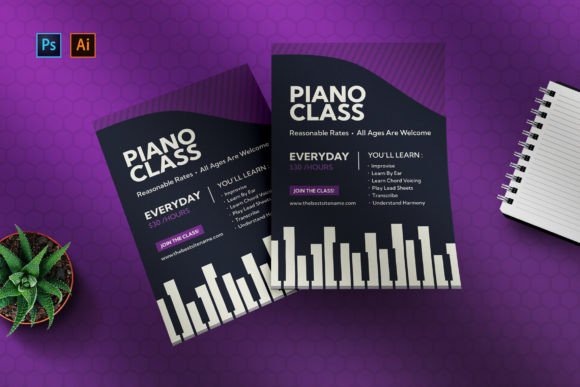
Unlocking Professional Design: A Comprehensive Guide to the Pianocs Poster Template
In the fast-paced world of modern business, visual communication is not just an advantage; it is a necessity. Whether you are running a logistics company, managing a creative agency, or promoting a local service, the ability to convey your message clearly and attractively can determine the success of your marketing efforts. This is where professional design tools come into play. Specifically, templates like the Pianocs - Poster Template have emerged as essential resources for businesses seeking high-quality, customizable visual assets without the steep learning curve or cost associated with hiring a dedicated design team.
This article explores the significance of using versatile poster templates in today’s corporate landscape. We will delve into what makes the Pianocs template a valuable asset, how it serves various industries—from transportation to corporate services—and why understanding the technical specifications of design files is crucial for achieving professional results.
The Role of Poster Templates in Modern Business
A poster template is more than just a pre-made layout; it is a strategic tool designed to streamline the creative process. For many businesses, especially small to medium-sized enterprises (SMEs), the barrier to entry for high-end graphic design has traditionally been high. Hiring a professional designer for every flyer, announcement, or promotional poster can be prohibitively expensive and time-consuming.
Templates bridge this gap by providing a structured foundation. They offer a professionally balanced composition, ensuring that elements like typography, imagery, and white space work together harmoniously. The Pianocs - Poster Template is a prime example of this utility. It is crafted to be adaptable across a wide spectrum of industries, including but not limited to:
- Corporate and Business: For annual reports, internal announcements, or conference promotions.
- Creative Agencies: To showcase portfolio pieces or announce new service offerings.
- Logistics and Transportation: Ideal for companies dealing with trucks, planes, trains, and freight services.
- Service Providers: From cleaning services to IT support, any service-based business can utilize these layouts to highlight their value proposition.
The versatility of such a template means that a single purchase can serve multiple departments within a company. A logistics firm might use it to advertise a new shipping route, while the HR department could use the same structural layout to recruit new drivers. This flexibility underscores the practical relevance of investing in high-quality, editable design assets.
Customization: The Key to Brand Identity
One of the most common misconceptions about using templates is that they result in generic, cookie-cutter designs. However, modern templates like Pianocs are built with full editability in mind. The true power of a template lies in its malleability. Users are not stuck with the default appearance; instead, they are provided with a robust framework that can be altered in every conceivable way.
You can change colors to match your specific brand guidelines, swap out fonts to reflect your company’s tone of voice, and modify backgrounds to suit the mood of your campaign. Furthermore, the ability to insert your own photos allows for genuine personalization. For instance, a transportation company can replace stock imagery with high-resolution photos of their actual fleet of trucks or planes. This level of customization ensures that while the structural integrity of the design remains professional, the final output is uniquely yours.
Technical Specifications and Why They Matter
For those new to graphic design, the technical jargon surrounding file formats and print specifications can be intimidating. However, understanding these details is vital for ensuring that your final printed product looks as good on paper as it does on screen. The Pianocs - Poster Template comes with a set of features that cater to both beginners and experienced designers, ensuring a smooth workflow from creation to production.
File Formats: AI, EPS, and PSD
The template includes files in three major formats: AI (Adobe Illustrator), EPS (Encapsulated PostScript), and PSD (Photoshop Document). Each format serves a specific purpose:
- AI and EPS: These are vector-based formats. Vector graphics use mathematical equations to create images, which means they can be scaled up or down infinitely without losing quality. This is crucial for large-format printing, such as A3 posters, where pixelation would be visible in lower-quality files.
- PSD: This is a raster-based format used in Adobe Photoshop. It is ideal for designs that rely heavily on photo editing, layer effects, and complex compositing. The inclusion of PSD files makes the template accessible to users who are more comfortable with Photoshop than Illustrator.
Having access to all three formats ensures compatibility with the software you already own and provides flexibility depending on the complexity of your design changes.
Print-Ready Quality: CMYK and 300 DPI
When designing for print, color accuracy and resolution are paramount. The Pianocs template is set to CMYK color mode. Unlike RGB (Red, Green, Blue), which is used for screens, CMYK (Cyan, Magenta, Yellow, Key/Black) is the standard color model for printing. Designing in CMYK ensures that the colors you see on your monitor closely match what comes out of the printer, preventing unpleasant surprises like dull or shifted colors.
Additionally, the template is configured at 300 DPI (Dots Per Inch). DPI refers to the density of printed dots. A resolution of 300 DPI is the industry standard for high-quality print materials. Anything lower may result in blurry or pixelated images, while higher resolutions are often unnecessary for standard poster printing and can increase file size unnecessarily. By starting with a 300 DPI, 11.7 x 16.5 Inch (A3) canvas, users can rest assured that their final output will be crisp and professional.
Usability and Organization
A well-designed template is not just about aesthetics; it is about workflow efficiency. The Pianocs template features well-organized layers. In design software, layers allow you to stack different elements (text, images, shapes) on top of each other. When these layers are named and grouped logically, it becomes incredibly easy to locate and edit specific parts of the design. For a beginner, this organization reduces the frustration of hunting for hidden elements. For an experienced designer, it speeds up the editing process significantly.
Furthermore, the template utilizes free fonts. This is a critical feature for accessibility. Many premium templates require the purchase of expensive proprietary fonts, which can add hidden costs and legal complexities. By using free fonts, the Pianocs template ensures that anyone can open, edit, and print the design without needing to license additional typefaces. This inclusivity makes it an excellent choice for startups, students, and non-profit organizations.
Support and Documentation
Even with a user-friendly design, questions may arise. The inclusion of a Help File is a testament to the creator’s commitment to user experience. This documentation typically guides users through the process of opening files, replacing images, and exporting for print. It serves as a safety net, ensuring that even those with minimal design experience can achieve professional results.
It is important to note, however, that preview images are not included in the download package. This is a standard practice in digital asset sales to protect intellectual property. Users should be prepared to source their own imagery or use the placeholders provided in the template to insert their own content.
Conclusion: Elevating Your Visual Communication
In conclusion, the Pianocs - Poster Template represents a powerful intersection of affordability, professionalism, and flexibility. It democratizes access to high-quality design, allowing businesses in sectors ranging from logistics to creative services to produce compelling visual materials. By understanding the technical benefits—such as CMYK color modes, 300 DPI resolution, and vector scalability—users can leverage this tool to enhance their brand presence effectively.
Whether you are looking to promote a new service, announce a corporate event, or simply improve your internal communications, investing in a versatile, fully editable template like Pianocs is a smart strategic move. It saves time, reduces costs, and ensures that your message is delivered with the clarity and impact it deserves. As visual content continues to dominate modern communication, having the right tools to create it is no longer optional—it is essential.