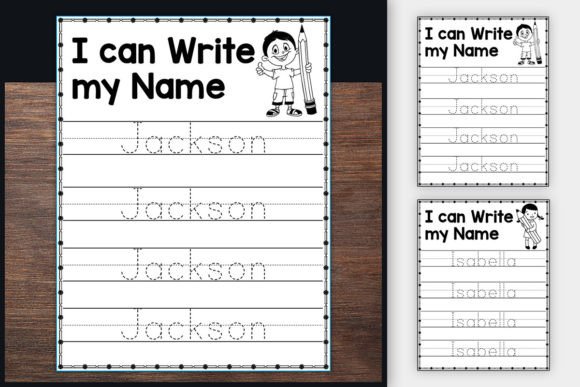
Editable Name Writing Practice Sheet: A Practical Tool for Personalized Learning
There is a distinct moment in early education when a child realizes that the squiggles on the page actually mean something. It is usually their name. That recognition is powerful. It builds identity, confidence, and a sudden, fierce interest in holding a pencil correctly. For educators, parents, and homeschoolers, capturing that momentum is critical. This is where an Editable Name Writing Practice Sheet becomes more than just a worksheet; it becomes a bridge between abstract letter shapes and personal meaning.
Generic worksheets have their place, but they often fail to hold a child’s attention for long. When a student sees the name "John" or "Maria" printed clearly at the top of a page, ready to be traced and then replicated, the task shifts from rote memorization to personal expression. By using customizable resources, you empower learners to take ownership of their progress. This approach transforms a mundane motor skill exercise into a meaningful activity that fosters pride and motivation.
Why Customization Matters in Early Literacy
The primary advantage of using an editable resource, such as a PowerPoint-based template, is flexibility. Every child learns at a different pace and has different interests. A static PDF might offer ten pages of practice, but if those pages feature names irrelevant to the student, the engagement drops. With an Editable Name Writing Practice Sheet, you can tailor the content instantly.
Consider the cognitive load involved in learning to write. A child must recognize the letter, recall its shape, coordinate hand movements to form it, and understand its sequence within a word. When the word is their own name, the emotional connection aids memory retention. They are not just drawing lines; they are writing themselves. This sense of ownership boosts confidence. A child who successfully traces and writes their name feels a tangible sense of achievement, which encourages them to tackle more complex words later.
Real-World Applications for Educators and Parents
The utility of these sheets extends far beyond the traditional kindergarten classroom. Here is how different users can integrate this tool into their daily routines effectively.
The Homeschool Environment
In a homeschool setting, resources need to be versatile. You might be teaching multiple children of different ages simultaneously. An editable template allows you to create personalized packets for each child in minutes. For a preschooler, you might focus on uppercase letters to start. For an older sibling who is refining their cursive or lowercase formation, you can adjust the font or style accordingly. The ability to print high-quality, 8.5x11 inch pages on demand means you never run out of practice material, and you avoid the waste of unused generic workbooks.
Special Education and Occupational Therapy
Fine motor skills development is a core component of occupational therapy. Therapists often work with children who struggle with grip strength, hand-eye coordination, or letter formation. An Editable Name Writing Practice Sheet allows therapists to isolate specific challenges. If a child struggles with the curvature of the letter "S," the therapist can create a sheet that emphasizes that specific letter within the context of the child’s name. The combination of uppercase and lowercase letters on a single sheet helps reinforce proper capitalization rules while providing varied motor patterns to practice.
Classroom Management and Identity Building
Teachers can use these sheets for more than just handwriting practice. At the beginning of the school year, creating name tags or desk plates using the same fonts and styles from the tracing sheets creates visual consistency. When students see their name written correctly on their desk, on their cubby, and on their practice sheet, it reinforces letter recognition. Furthermore, these sheets can be transformed into editable name tags for various classroom activities, helping students associate their written name with their physical presence in the room.
Technical Features That Enhance Usability
When selecting a resource, the format matters as much as the content. A high-quality Editable Name Writing Practice Sheet should be built on a platform that is accessible to most users. PowerPoint (PPT/PPTX) is ideal because it is widely understood and easy to edit. You do not need graphic design skills to change a text box.
- Free Font Inclusion: Many templates come with a free font that mimics standard handwriting instruction styles. This ensures that the letters look familiar to students who are learning standard print formations.
- High-Quality Print Ready: The specifications should guarantee crisp lines. Blurry dashed lines make it difficult for children to trace accurately, leading to frustration. A resolution suitable for 8.5x11 inch printing ensures that every curve and corner is visible.
- Ample Practice Space: A good template provides enough rows for repetition. Ten printable pages offer sufficient volume for practice without overwhelming the student. It allows for gradual improvement over several sessions.
What to Consider Before Downloading
While the benefits are clear, choosing the right resource requires a bit of foresight. Not all editable sheets are created equal. Here are practical considerations to keep in mind before you commit to a download.
Font Legibility: Ensure the font used in the template closely matches the handwriting style taught in your region or school. Some decorative fonts look nice but confuse beginners because they add unnecessary flourishes. Stick to simple, clean sans-serif or standard manuscript styles.
Ease of Editing: Test the file. Can you easily type in a long name? Does the text box expand automatically, or do you have to manually resize it? A user-friendly template saves time, especially if you are creating sheets for a whole class of twenty-plus students.
Versatility: Look for resources that allow for both uppercase and lowercase combinations. Young learners often start with all caps, but transitioning to proper capitalization (first letter big, rest small) is a crucial step. A sheet that supports both formats offers longer-term value.
Beyond the Worksheet: Extending the Learning
The Editable Name Writing Practice Sheet is a starting point, not the end goal. To maximize its impact, integrate it into broader learning activities. For instance, after tracing their name, ask the student to identify the first letter. Have them circle all instances of the first letter in their name. This connects handwriting with phonics and letter recognition.
You can also use the printed sheets for tactile learning. Place a piece of paper over the traced name and have the student rub a crayon over it to create a rubbing. Or, use the sheet as a guide for writing in sand, shaving cream, or with playdough. These multisensory approaches reinforce the muscle memory developed during tracing.
For entrepreneurs and small business owners in the education sector, offering these customizable sheets can be a valuable addition to your product line. Parents are constantly seeking personalized tools that make learning feel special. By providing a resource that is easy to edit and print, you solve a real problem for busy parents and teachers who want to provide high-quality, individualized practice without spending hours designing materials from scratch.
Final Thoughts on Fostering Writing Joy
Writing is a foundational skill, but it does not have to be a chore. By using an Editable Name Writing Practice Sheet, you introduce an element of personal relevance that generic drills lack. You support the development of fine motor skills, letter recognition, and proper capitalization in a way that respects the individual learner’s identity.
Whether you are a teacher managing a diverse classroom, a parent navigating early literacy at home, or a therapist working on motor coordination, this tool offers a practical, efficient solution. It empowers you to create meaningful learning experiences quickly and effectively. Invest in resources that adapt to your needs, and watch as students engage with greater enthusiasm and confidence. The joy of writing begins with the joy of seeing one’s own name on the page, written well.