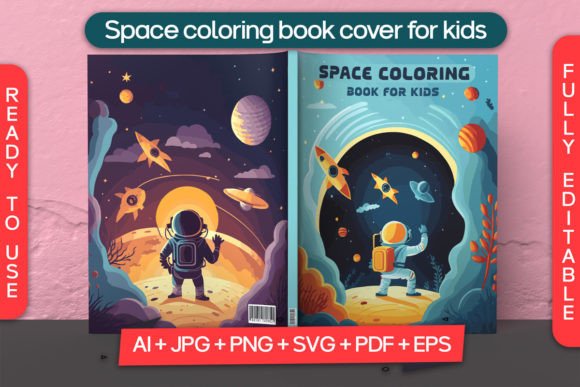
Space Coloring Book Cover for Kids: A Complete Design Guide
In the vibrant world of children’s publishing, first impressions are not just important—they are decisive. Parents, educators, and young readers themselves are drawn to visuals that spark imagination before a single page is turned. This is where a professionally designed Space Coloring Book Cover for Kids becomes an essential asset. Whether you are an independent author, a small business owner launching an educational series, or a graphic designer seeking efficient workflows, understanding the mechanics and value of high-quality cover templates can transform your publishing journey.
The demand for space-themed content has surged in recent years. From astronauts and rockets to distant galaxies and alien landscapes, the cosmos offers endless creative possibilities. However, translating that creativity into a market-ready product requires more than just artistic talent; it demands technical precision and strategic design. This article explores how utilizing a customizable cover template can streamline your process, ensuring your book stands out on both physical shelves and digital marketplaces.
Why Visual Appeal Matters in Children’s Books
Children are visual learners. When browsing for a new activity book, they are rarely influenced by blurbs or author bios. Instead, they are captivated by color, character, and composition. A Space Coloring Book Cover for Kids serves as the primary gateway to the content inside. It sets the tone for the experience, promising adventure, fun, and learning.
For authors and publishers, this means that the cover must do heavy lifting. It needs to communicate the theme instantly while maintaining a level of professionalism that assures parents of the quality within. A cluttered or low-resolution image can signal poor production values, potentially driving away potential buyers. Conversely, a crisp, engaging, and well-structured cover invites interaction. It suggests that the pages inside are equally cared for, increasing the perceived value of the product.
The Role of Customization in Unique Branding
One of the most significant advantages of using a template-based approach is the balance between efficiency and uniqueness. Many creators fear that using a template will result in a generic look. However, modern design resources are built with flexibility in mind. A highly customizable cover template allows you to edit and transform elements into something completely unique.
Consider the layers involved in a professional design file. You are not stuck with preset fonts or static graphics. With editable layers, you can adjust:
- Typography: Change fonts to match your brand voice, whether playful and bubbly or sleek and futuristic.
- Graphics: Swap out specific space elements—replace a rocket with a satellite, or add additional stars and planets to fill negative space.
- Colors: Adjust the palette to suit current trends or specific marketing campaigns. Perhaps you want a neon cyber-space look instead of traditional deep blues and blacks.
- Backgrounds: Modify the depth and texture of the background to ensure text readability and visual harmony.
This level of control ensures that while you save time on the structural setup, the final output remains distinctively yours. It allows for rapid iteration, meaning you can test different visual concepts without starting from scratch each time.
Technical Specifications: What Makes a Cover Print-Ready?
Designing for print is fundamentally different from designing for screens. A common mistake among new self-publishers is uploading files that look great on a monitor but appear blurry or color-shifted when printed. To avoid this, understanding the technical specifications of your Space Coloring Book Cover for Kids template is crucial.
A professional-grade template typically adheres to strict industry standards. Here is what you should look for and why it matters:
- Dimensions and Bleed: Standard sizes, such as 8.5 x 11 inches, are common for coloring books. However, the file must include bleed areas—extra space around the edges that gets trimmed off during printing. This ensures no white borders appear if the cut is slightly off-center.
- Resolution (DPI): Images must be at least 300 DPI (dots per inch). Anything lower, such as 72 DPI used for web images, will result in pixelation and blurriness in print.
- Color Mode (CMYK): Screens use RGB (Red, Green, Blue) light, while printers use CMYK (Cyan, Magenta, Yellow, Key/Black) ink. A template prepared in CMYK ensures that the colors you see on screen are as close as possible to the final printed product, preventing unexpected shifts in hue.
- Vector Fonts: Using 100% vector fonts ensures that text remains crisp at any size. Unlike raster images, vectors do not lose quality when scaled. Remember to install these fonts before opening the file to avoid substitution errors.
By starting with a template that already meets these criteria, you eliminate the guesswork. You can focus on creativity rather than troubleshooting technical errors during the pre-flight check.
File Formats and Their Uses
Versatility is key in modern publishing. You may need to send a file to a local printer, upload to an online platform like Amazon KDP, or use images for social media marketing. A comprehensive download package should include multiple file formats to cover all these bases.
Typically, a robust template package includes:
- AI (Adobe Illustrator): The primary editable file. This layered format allows for maximum customization using industry-standard software.
- EPS Files: Encapsulated PostScript files are also editable and widely compatible with various vector graphic programs, offering flexibility if you do not use Adobe products.
- PDF Files: High-resolution PDFs are often required for direct printing. They lock in the design elements, ensuring nothing shifts during transmission to the printer.
- PNG and JPG Files: These raster images are essential for online use. A 300 PPI PNG with a transparent background can be useful for overlaying designs, while JPGs are ideal for quick previews, email attachments, or social media posts.
- SVG Files: Scalable Vector Graphics are increasingly important for web use and digital cutting machines, adding another layer of utility for crafters and digital marketers.
Who Benefits from Using Cover Templates?
The utility of a Space Coloring Book Cover for Kids extends beyond just graphic designers. Various professionals and creators can leverage these tools to enhance their productivity and output quality.
Independent Authors and Self-Publishers: For those managing every aspect of their book’s production, time is a scarce resource. A template reduces the design phase from days to hours, allowing authors to focus on writing and marketing.
Educators and School Administrators: Teachers creating custom activity books for STEM programs can use these templates to produce professional-looking materials that engage students. The space theme aligns perfectly with science curricula, making learning visually appealing.
Small Business Owners: Gift shops, museums, and educational centers often sell branded merchandise. A customizable template allows them to quickly adapt designs for seasonal promotions or special events without hiring external agencies.
Graphic Designers: Even experienced designers benefit from templates. They serve as a solid foundation or inspiration, speeding up the initial draft process and allowing designers to bill for more projects due to increased efficiency.
Practical Applications and Real-World Scenarios
Imagine you are launching a series of educational books about the solar system. You need consistent branding across five different volumes. Using a single, highly customizable template ensures that each book shares a cohesive look—same font hierarchy, similar layout structure—while allowing for unique planetary illustrations on each cover. This consistency builds brand recognition and encourages collectors to buy the entire set.
Alternatively, consider a parent-teacher association organizing a fundraising event. They might create a limited-edition coloring book featuring student artwork. By using a pre-made template, they can quickly insert the winning drawings into a professional layout, producing a high-quality souvenir that reflects well on the organization.
Evaluating Suitability for Your Project
Before selecting a template, assess your specific needs. Do you have access to software like Adobe Illustrator? If not, look for templates that offer PDF or EPS compatibility with free alternatives like Inkscape. Consider your distribution method: if you are primarily selling online, ensure the template includes high-quality JPGs for thumbnail optimization. If you are printing locally, verify that the CMYK color profile matches your printer’s requirements.
It is also wise to review the license terms. Ensure that the template allows for commercial use if you intend to sell the final book. Most professional templates grant this right, but always double-check to avoid legal complications.
Conclusion
A Space Coloring Book Cover for Kids is more than just a decorative element; it is a critical component of your book’s success. By leveraging high-quality, customizable templates, you can achieve professional results without the steep learning curve of advanced graphic design. The combination of technical readiness—such as 300 DPI resolution and CMYK color mode—and creative flexibility empowers you to produce unique, eye-catching covers efficiently.
Whether you are an author, educator, or entrepreneur, embracing these tools can streamline your workflow and elevate your product’s appeal. In a competitive market, the ability to quickly adapt and produce high-standard visuals is a significant advantage. Start with a solid foundation, customize it to reflect your vision, and let your creative content shine.